
Mouse Monoclonal Antibody
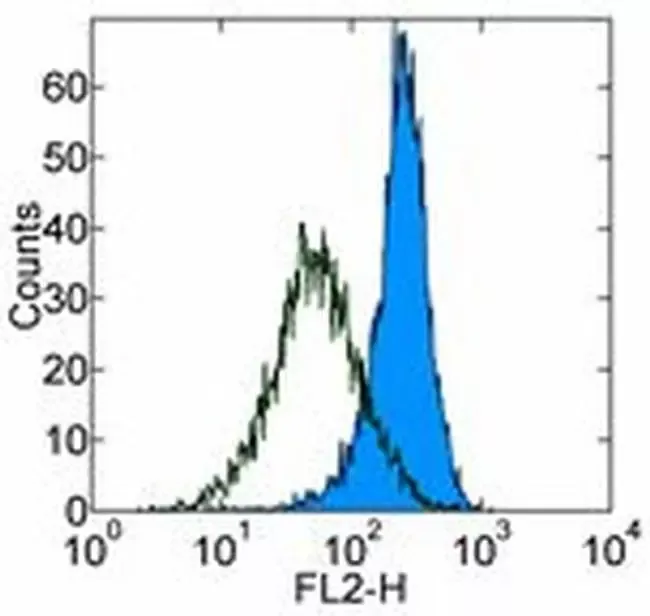
Description: The WM-15 monoclonal antibody reacts with human CD13, also known as aminopeptidase N. CD13 is a transmembrane ectoenzyme occurring on monocytes and granulocytes but not lymphocytes in blood. It is also reportedly on a wide variety of cells and in a wide variety of tissues, including endothelial cells, epithelial cells, fibroblasts, kidney proximal tubules, intestine, and placenta. CD13 is reported to have many different functions including degradation of enkephalins and endorphins, terminal degradation of peptides, amino acid scavenging, antigen processing, and adhesion and migration of cells. Applications Reported: This WM-15 (WM15) antibody has been reported for use in flow cytometric analysis. Applications Tested: This WM-15 (WM15) antibody has been pre-titrated and tested by flow cytometric analysis of normal human peripheral blood cells. This can be used at 5 μL (0.5 μg) per test. A test is defined as the amount (μg) of antibody that will stain a cell sample in a final volume of 100 μL. Cell number should be determined empirically but can range from 10^5 to 10^8 cells/test. Light sensitivity: This tandem dye is sensitive photo-induced oxidation. Please protect this vial and stained samples from light. Fixation: Samples can be stored in IC Fixation Buffer (Product 00-822-49) (100 μL cell sample + 100 μL IC Fixation Buffer) or 1-step Fix/Lyse Solution (Product 00-5333-54) for up to 3 days in the dark at 4°C with minimal impact on b…
CD13, also known as ANPEP, is a 150-170 kDa type II transmembrane zinc-binding ectopeptidase expressed on a wide variety of cell types and tissues. It is prominently found on monocytes and granulocytes in the blood, but not on lymphocytes. Additionally, CD13 is expressed on endothelial cells, epithelial cells, fibroblasts, kidney proximal tubules, intestine, placenta, and myeloid leukemia cells. As a metalloprotease, CD13 preferentially catalyzes the removal of neutral amino acids from small peptides, thereby activating or inactivating bioactive peptides. It plays a crucial role in various biological processes, including the degradation of enkephalins and endorphins, terminal degradation of peptides, amino acid scavenging, antigen processing, and the adhesion and migration of cells. CD13 is also involved in extracellular matrix degradation, signal transduction, inflammatory responses, regulation of intercellular contact, cell motility, and vascularization. In the context of disease, CD13 is associated with the protection of leukemic cells against apoptosis and is linked to a poor prognosis in carcinomas. Furthermore, CD13 functions as an aminopeptidase enzyme and serves as an alpha receptor for coronavirus. Trusted Sustainability Partner
Suppliers who meet our established requirements for corporate social responsibility
Learn More” alt=”TRUSTED_SUSTAINABILITY” title=”TRUSTED_SUSTAINABILITY” />