
Mouse Monoclonal Antibody
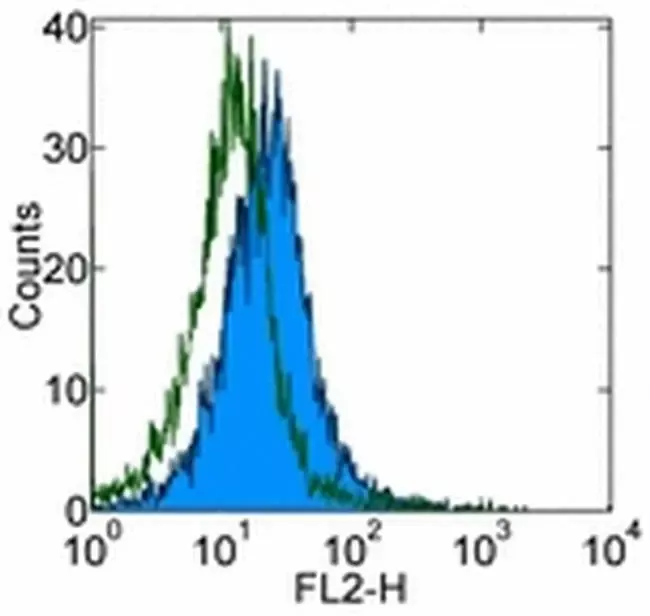
Description: The OX8 monoclonal antibody reacts with rat CD8 alpha. CD8 alpha is a member of the immunoglobulin superfamily which heterodimerizes with CD8 beta to form the CD8 antigen expressed on CD4+CD8+, double-positive thymocytes, the majority of MHC class I-restricted peripheral T cells, and on some macrophages. CD8 binds to MHC class I expressed on the surface of antigen-presenting cells during antigen presentation, and participates in T-cell receptor signal transduction through association with the kinase Lck. Applications Reported: This OX8 antibody has been reported for use in flow cytometric analysis. Applications Tested: This OX8 antibody has been tested by flow cytometric analysis of rat splenocytes. This can be used at less than or equal to 0.25 μg per test. A test is defined as the amount (μg) of antibody that will stain a cell sample in a final volume of 100 μL. Cell number should be determined empirically but can range from 10^5 to 10^8 cells/test. It is recommended that the antibody be carefully titrated for optimal performance in the assay of interest. Light sensitivity: This tandem dye is sensitive photo-induced oxidation. Please protect this vial and stained samples from light. Fixation: Samples can be stored in IC Fixation Buffer (cat. 00-8222) (100 μL cell sample + 100 μL IC Fixation Buffer) or 1-step Fix/Lyse Solution (cat.
CD8, also known as cluster of differentiation 8, is a type I transmembrane glycoprotein of the immunoglobulin family that plays a crucial role in T cell differentiation, activation, and signal transduction. It is expressed as either a heterodimer (CD8 alpha beta) or a homodimer (CD8 alpha alpha). The CD8 alpha beta form is predominantly found on the majority of thymocytes and a subpopulation of mature alpha beta TCR T cells, while the CD8 alpha alpha form is expressed on gamma delta TCR T cells, a subset of intestinal intraepithelial lymphocytes (IELs), and dendritic cells. CD8 functions as a co-receptor for major histocompatibility complex class I (MHC-I) molecules, working alongside the T cell receptor (TCR). The CD8 alpha chain is essential for binding to MHC-I. CD8 is also expressed on a subset of T cells, NK cells, monocytes, and dendritic cells as disulfide-linked homodimers of CD8 alpha. Upon ligation of MHC-I/peptide complexes presented by antigen-presenting cells (APCs), CD8 recruits lymphocyte-specific protein tyrosine kinase (Lck), leading to lymphokine production, increased motility, and activation of cytotoxic T lymphocytes (CTLs). Activated CTLs are vital for clearing pathogens and tumor cells. The differentiation of naive CD8+ T cells into CTLs is strongly enhanced by cytokines such as IL-2, IL-12, and TGF-beta1. Through its interactions with MHC-I and association with protein tyrosine kinase p56lck, CD8 plays a significant role in T cell development and the activation of mature T cells. Trusted Sustainability Partner
Suppliers who meet our established requirements for corporate social responsibility
Learn More” alt=”TRUSTED_SUSTAINABILITY” title=”TRUSTED_SUSTAINABILITY” />